
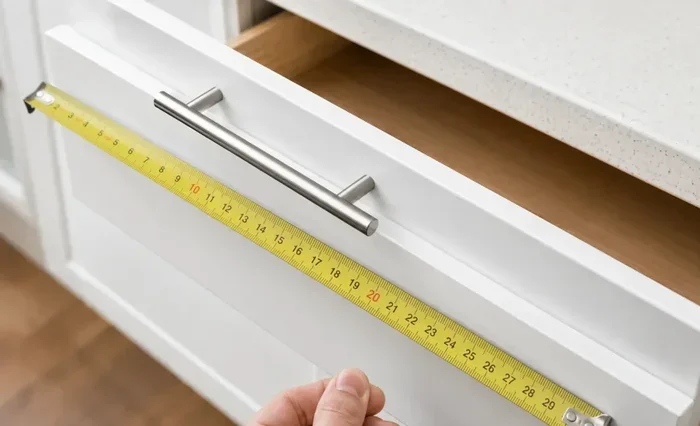
Measuring kitchen cabinet handles correctly ensures a perfect fit and a polished look in your kitchen. This guide walks you through every step, from tools needed to common mistakes to avoid. You will learn how to measure different handle types, understand center-to-center spacing, and choose the right size for your cabinets.
Measuring kitchen cabinet handles might seem like a small detail. But it makes a huge difference in how your kitchen looks and feels. A handle that is too long, too short, or placed at the wrong angle can ruin the entire look of your cabinets. That is why getting the right measurements matters so much.
Whether you are replacing old handles or installing new ones for the first time, this guide has you covered. We will walk you through every step of the process. You will learn what tools to use, how to measure different handle types, and the mistakes most people make. By the end, you will feel confident measuring your kitchen cabinet handles like a pro.
The good news is that measuring handles is not hard. With the right approach and a little patience, anyone can do it. Let us get started.
Key Takeaways
- Always measure center-to-center distance: This is the most important measurement for cabinet handles and drawer pulls.
- Use the right tools: A measuring tape and a template make the process quick and accurate.
- Measure twice, install once: Double-checking prevents costly mistakes and wasted time.
- Different handle types need different measurements: Knobs, pulls, and levers all require unique approaches.
- Consider your cabinet size: Handle length should match the size of your cabinet doors and drawers.
- Avoid common pitfalls: Skipping the template test or ignoring door thickness can lead to problems.
📑 Table of Contents
- Why Measuring Kitchen Cabinet Handles Correctly Matters
- Tools You Need to Measure Cabinet Handles
- How to Measure Different Handle Types
- Common Mistakes When Measuring Kitchen Cabinet Handles
- Step-by-Step Measuring Guide
- Tips for Choosing the Right Handle Size
- Frequently Asked Questions About Measuring Kitchen Cabinet Handles
- Conclusion
Why Measuring Kitchen Cabinet Handles Correctly Matters
Getting the right measurement for your cabinet hardware is more important than most people think. A wrong measurement can lead to handles that do not fit, look crooked, or function poorly. Here is why accuracy matters.
First, properly measured handles improve the overall look of your kitchen. When handles are evenly spaced and the right size, everything feels balanced. Your eye naturally follows the lines of the cabinets, and the result looks clean and professional.
Second, correct measurements ensure smooth operation. A handle that is too long might bump into the backsplash. One that is too short might not give you enough leverage to open a heavy drawer. Getting it right means your kitchen works as well as it looks.
Third, accurate measurements save you money. Buying the wrong handles means returns, extra shipping costs, and wasted time. A simple measuring session before you shop can prevent all of that.
The Role of Cabinet Hardware in Kitchen Design
Your cabinet hardware includes knobs, pulls, and levers. These small pieces play a big role in your kitchen’s style. They are one of the first things people notice when they look at your cabinets. Choosing the right size and style of kitchen cabinet handles can completely transform the feel of your space.
Think of handles as the jewelry of your kitchen. Too big, and they overwhelm. Too small, and they get lost. The right size creates harmony between your cabinets, countertops, and backsplash.
Tools You Need to Measure Cabinet Handles
You do not need fancy equipment to measure kitchen cabinet handles. A few basic tools are all it takes. Here is what you should have ready before you start.
Essential Measuring Tools
- Standard measuring tape: A flexible cloth or metal tape works best for measuring distances between screw holes.
- Ruler or straight edge: Helpful for measuring the length of longer drawer pulls.
- Pencil and paper: You need to write down your measurements. Do not trust your memory.
- Handle measuring template: A plastic template with pre-marked holes makes the job faster and easier.
- Level: A small bubble level helps you check that handles are straight.
Optional but Helpful Tools
- Drill bit size guide: Useful if you need to know the diameter of existing screw holes.
- Camera or phone: Take photos of your current handles from multiple angles for reference.
- Masking tape: Mark drill spots on your cabinet doors before making holes.
Having these tools ready before you start will make the process smooth. You will not have to stop midway to find something you need.
How to Measure Different Handle Types
Not all kitchen cabinet handles are the same. Different types require different measuring approaches. Let us break down each type so you know exactly what to do.
Measuring Single-Mount Knobs
Single-mount knobs are the most common type. They attach with one screw through the door. To measure them, you need two key numbers.
- Knob diameter: Measure across the widest part of the knob ball or shape. This tells you how big the handle looks.
- Screw post length: Measure from the base of the knob to the end of the screw post. This ensures the post is long enough to go through your cabinet door.
Also check the door thickness. Most cabinet doors are about 1 inch to 1.5 inches thick. If your door is thicker, you need a longer screw post.
Measuring Drawer Pulls
Drawer pulls come in many lengths and styles. The most important measurement is the center-to-center distance. This is the space between the two screw holes.
Here is how to do it:
- Place your measuring tape at the center of one screw hole.
- Stretch it to the center of the other screw hole.
- Write down that number in inches or millimeters.
Common center-to-center measurements for drawer pulls are 3 inches, 4 inches, 5 inches, and 6 inches. Some pulls have a single center mount, which is much simpler to measure.
Measuring Lever Handles
Lever handles are popular for their modern look and easy use. They are common on cabinet doors and drawers. To measure them:
- Measure the overall length of the lever from end to end.
- Check the handle spacing between the mounting points if it is a two-hole lever.
- Measure the lever height, especially if the door is shallow.
Lever handles come in both center mount and side mount styles. Center mount levers attach through one hole, while side mount levers use two holes on the same side of the door.
Common Mistakes When Measuring Kitchen Cabinet Handles
Even experienced DIYers make mistakes when measuring cabinet hardware. Knowing what to avoid saves time and frustration.
Skipping the Template Test
A handle measuring template is a cheap and easy tool that takes the guesswork out of the process. Many people skip it and end up with misaligned holes. Using a template before drilling is one of the best habits you can build.
Guessing Instead of Measuring
Never guess measurements. Even a quarter-inch difference can change how a handle fits. Always measure from the center of one screw hole to the center of the other. This is called the center-to-center measurement and it is the standard for cabinet hardware.
Ignoring Door Thickness
Not all cabinet doors are the same thickness. Thin doors need shorter screws. Thick doors need longer ones. Measuring door thickness before buying handles prevents a frustrating install.
Forgetting to Check Handle Length vs. Door Size
A long drawer pull on a small drawer looks awkward. A short pull on a large drawer looks lost. Match the pull length to the size of the cabinet door or drawer front for the best visual balance.
Not Accounting for the Backsplash
If your cabinets sit close to the backsplash, a long handle might hit the wall. Always measure the space between the cabinet edge and the backsplash before choosing a pull length.
Step-by-Step Measuring Guide
Now that you know the tools and common mistakes, let us walk through the actual process. Follow these steps to measure your kitchen cabinet handles accurately.
Step 1: Remove the Existing Handle
Unscrew the handle from the cabinet door or drawer. Keep the screws in a small bag so you do not lose them. This gives you clear access to the holes and lets you see what the old hardware looked like.
Step 2: Measure the Center-to-Center Distance
This is the most important measurement. Place your measuring tape at the center of one screw hole and extend it to the center of the other. Write this number down clearly. For knobs, this step may not apply since they use a single hole.
Step 3: Measure the Overall Handle Length
For drawer pulls and lever handles, measure from one end to the other. This helps you choose a replacement that looks proportional to your cabinet.
Step 4: Measure the Screw Hole Diameter
Use a drill bit or ruler to check the width of the existing screw holes. This matters if you are switching brands or styles and the screw sizes differ.
Step 5: Check the Door or Drawer Thickness
Use your measuring tape to check how thick the cabinet door or drawer front is. This determines the screw length you need for a secure fit.
Step 6: Use a Template to Confirm
Place a handle measuring template over the existing holes. Match the template holes to your screw holes. This confirms your measurements and helps you visualize how the new handle will look.
Following these six steps ensures you get every measurement right. You will walk into a store or open an online shop with confidence.
Tips for Choosing the Right Handle Size
Once you have your measurements, it is time to choose new kitchen cabinet handles. Here are some tips to help you pick the best ones for your space.
Match Handle Size to Cabinet Scale
Large cabinets with big doors look best with longer pulls. Small cabinets or glass-front cabinets look better with shorter pulls or knobs. A good rule of thumb is that the handle should take up about one-third to one-half of the door width.
Consider the Style of Your Kitchen
Modern kitchens often look great with sleek lever handles. Traditional kitchens pair well with classic knobs. Rustic kitchens benefit from wrought iron or brushed nickel pulls. Your cabinet hardware should complement your kitchen’s overall style.
Think About Function
Drawer pulls that are too short can be hard to grip. If you have heavy drawers, choose a longer pull that gives you a comfortable hold. For cabinet doors, knobs are often easier to use than pulls.
Stick to a Consistent Look
Mixing too many handle styles can make your kitchen look cluttered. Pick one style and finish for all your cabinets. You can use one style on doors and another on drawers, but keep the finish the same.
Quick Tips for a Perfect Install
- Always mark your drill spots with a pencil before drilling.
- Use a level to make sure handles are straight.
- Start with a test hole in scrap wood if you are unsure.
- Keep a photo of your old handles on your phone for reference.
- Buy handles from a reputable brand to ensure consistent quality.
Expert Insights
Professional kitchen designers recommend measuring your kitchen cabinet handles at least twice before making any purchase. They also suggest considering the height at which handles are placed. Standard placement is about 3 to 4 inches from the bottom of the cabinet door. This height works well for most users and keeps things visually balanced.
Another expert tip is to consider the weight of the cabinet door or drawer. Heavy doors need sturdy handles with strong mounting points. Lightweight doors can handle almost any style.
Comparison: Common Handle Sizes
Here is a quick reference table for common handle sizes and their best uses.
| Handle Type | Common Sizes | Best For |
|---|---|---|
| Single Mount Knob | 1 inch to 1.5 inch diameter | Small cabinet doors, drawers |
| Drawer Pull (2-hole) | 3 inch, 4 inch, 5 inch center-to-center | Medium to large drawers |
| Long Drawer Pull | 6 inch to 12 inch overall length | Large drawers, pantries |
| Lever Handle (Center Mount) | 4 inch to 6 inch overall | Modern cabinet doors |
| Lever Handle (Side Mount) | 5 inch to 8 inch overall | Accessibility-friendly cabinets |
This table gives you a quick starting point. Always measure your specific cabinets before making a final decision.
Frequently Asked Questions About Measuring Kitchen Cabinet Handles
What is the standard center-to-center measurement for kitchen cabinet handles?
The most common center-to-center measurements are 3 inches, 4 inches, and 5 inches for drawer pulls. For knobs, there is no center-to-center measurement since they use a single screw hole. Always measure your specific cabinets to confirm the right size.
Can I use a handle template instead of a measuring tape?
Yes, a handle template is an excellent alternative. Templates come with pre-marked holes for common sizes. You simply hold the template over your existing holes and see which one matches. Many hardware stores sell them for just a few dollars.
How do I measure a single-screw cabinet knob?
For a single-screw knob, measure the diameter of the knob ball or decorative part. Also measure the length of the screw post to make sure it will go through your cabinet door thickness. These two numbers are all you need to find a replacement.
What if my cabinet doors are different sizes?
It is common for cabinet doors to vary in size, especially in older kitchens. Measure each door individually and choose handle sizes that look proportional. You can mix handle sizes on different doors as long as the style and finish match.
Should I measure in inches or millimeters?
Most cabinet handles in the United States are measured in inches. However, if you are buying imported handles or shopping online from international retailers, millimeters may be used. It helps to have both measurements handy to avoid confusion.
How do I measure for replacement handles without drilling new holes?
If you want to reuse the existing screw holes, measure the distance between them and the screw hole diameter. Then shop for replacement handles that match those exact specifications. This way, you do not need to fill old holes or drill new ones.
Conclusion
Measuring kitchen cabinet handles does not have to be intimidating. With the right tools, a clear process, and a little attention to detail, anyone can get accurate measurements. The key is to take your time, measure twice, and never guess.
Remember the center-to-center measurement for drawer pulls and the overall length for larger pulls and levers. Check your door thickness and screw hole sizes before you buy. Avoid the common mistakes that trip up most people, and use a template whenever possible.
Your kitchen deserves handles that look great and work perfectly. Now that you know how to measure kitchen cabinet handles the right way, you are ready to shop with confidence. Grab your measuring tape, follow the steps in this guide, and give your kitchen the upgrade it deserves.

