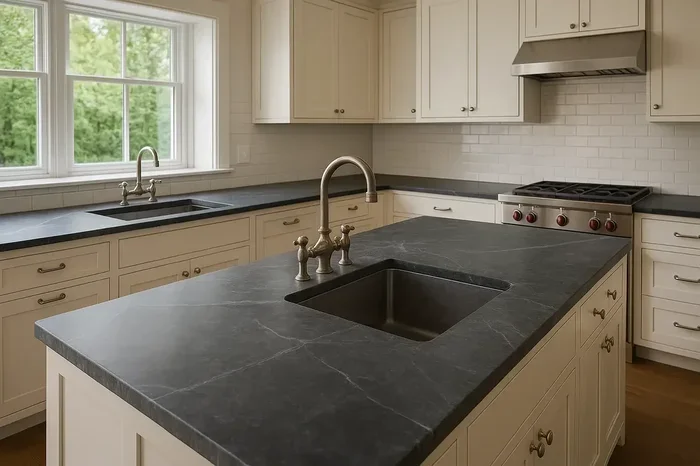
Soapstone kitchen countertops combine natural beauty with exceptional durability, making them a top choice for modern kitchens. This natural stone is heat resistant, non-porous, and develops a gorgeous patina over time. Whether you are renovating or building new, soapstone countertops offer a timeless look that lasts for decades.
Key Takeaways
- Natural Durability: Soapstone is incredibly tough, heat resistant, and resistant to stains and scratches.
- Unique Patina: Over time, soapstone develops a rich, darkened finish that adds character and charm to your kitchen.
- Low Maintenance: Unlike other natural stones, soapstone requires minimal sealing and easy upkeep.
- Versatile Aesthetic: Available in various shades of gray, green, and blue-gray tones to suit any kitchen style.
- Heat and Chemical Resistance: Soapstone can handle hot pots, pans, and common kitchen spills without damage.
- Long-Term Value: Investing in soapstone countertops boosts home value and offers decades of reliable use.
📑 Table of Contents
- Why Soapstone Kitchen Countertops Are a Smart Choice
- What Exactly Is Soapstone?
- Benefits of Soapstone Kitchen Countertops
- Soapstone vs Other Countertop Materials
- Colors and Styles of Soapstone
- How to Care for Soapstone Countertops
- Soapstone Countertop Cost and Installation
- Design Ideas for Soapstone Kitchen Countertops
- Common Myths About Soapstone Countertops
- Final Thoughts on Soapstone Kitchen Countertops
Why Soapstone Kitchen Countertops Are a Smart Choice
If you are planning a kitchen renovation, you have probably spent hours scrolling through countertop options. Granite, quartz, marble, butcher block — the list goes on. But there is one material that stands out for its timeless charm and rock-solid performance. Soapstone kitchen countertops are quietly becoming a favorite among homeowners and designers alike.
Soapstone is a natural metamorphic rock formed deep within the earth. It is made mostly of talc, which gives it a smooth, soft feel. Despite being soft to the touch, soapstone is remarkably durable. It resists heat, stains, and bacteria better than many other countertop materials. This makes it a practical and beautiful option for any kitchen.
What makes soapstone truly special is how it changes over time. New soapstone has a lighter, cooler tone. But with everyday use and a little mineral oil, it develops a deep, warm patina. No other countertop material offers this kind of living, evolving beauty. If you want a surface that tells a story, soapstone is your answer.
In this guide, we will cover everything you need to know about soapstone countertops. From benefits and costs to maintenance and installation tips, you will find all the details here. Let us dive in.
What Exactly Is Soapstone?
Soapstone is a natural stone quarried from the earth. It is composed mainly of talc, magnesite, and dolomite. The amount of talc determines how soft the stone feels. Higher talc content means a softer stone, while lower talc content means a harder, more durable slab.
Soapstone countertops have been used for centuries. In fact, Scandinavian and European kitchens have relied on soapstone for generations. Today, soapstone is mined in several countries, including Brazil, Finland, India, and the United States. Each region produces stone with slightly different colors and veining patterns.
Types of Soapstone
Not all soapstone is the same. There are two main categories you should know about when choosing soapstone kitchen countertops.
Architectural soapstone is harder and denser. It has lower talc content, which makes it more resistant to scratches and dents. This is the most popular choice for kitchen counters. It holds up well to daily kitchen life.
Artistic soapstone has a higher talc content. It is softer and easier to carve. This type is often used for sculptures and decorative items. It is not ideal for countertops because it can dent more easily.
When shopping for countertops, always ask for architectural-grade soapstone. It gives you the best balance of beauty and durability.
Benefits of Soapstone Kitchen Countertops
Soapstone kitchen countertops offer a long list of advantages that make them stand out from other materials. Let us look at the biggest benefits.
Heat Resistance
Soapstone is one of the most heat resistant countertop materials available. You can place a hot skillet, baking sheet, or cast iron pan directly on the surface. No trivet or hot pad is needed. This is a huge advantage over materials like quartz or granite, which can crack under extreme heat.
If you love cooking and often work with hot pots and pans, soapstone will give you peace of mind. Your countertop will not stain or discolor from heat exposure.
Stain Resistance
Soapstone is a non-porous natural stone. This means liquids do not soak into the surface. Wine, coffee, lemon juice, olive oil — none of these will leave a permanent stain on soapstone countertops. You do not need to seal it regularly like you would with marble or granite.
This makes soapstone a fantastic choice for busy kitchens where spills happen daily. Simply wipe the surface clean, and you are done.
Antibacterial Properties
Because soapstone is non-porous, bacteria and germs cannot penetrate the surface. This makes it a hygienic choice for food preparation areas. Many homeowners appreciate that soapstone kitchen countertops naturally resist mold and mildew growth.
Durability
Soapstone is a tough material. It resists scratches and dents better than marble or limestone. While it can develop minor marks over time, these actually add to the patina rather than detracting from the beauty. A well-maintained soapstone countertop can last a lifetime and beyond.
Eco-Friendly Choice
Soapstone is a natural, quarried material. It does not require chemical treatments or synthetic processes. It is also fully recyclable. If you are looking for an environmentally friendly countertop option, soapstone countertops are an excellent choice.
Soapstone vs Other Countertop Materials
Choosing a countertop material can be overwhelming. Let us compare soapstone with some of the most popular options on the market.
| Feature | Soapstone | Granite | Marble | Quartz |
|---|---|---|---|---|
| Heat Resistance | Excellent | Good | Poor | Poor |
| Stain Resistance | Excellent | Good | Poor | Excellent |
| Scratch Resistance | Good | Excellent | Poor | Good |
| Non-Porous | Yes | No (needs sealing) | No (needs sealing) | Yes |
| Patina Development | Yes | No | No (etches) | No |
| Maintenance Level | Low | Medium | High | Low |
| Natural Stone | Yes | Yes | Yes | No |
| Cost Range | Mid to High | Mid to High | Mid to High | Mid to High |
As you can see, soapstone holds its own against even the most popular countertop materials. Its unique combination of heat resistance, stain resistance, and patina development sets it apart. While quartz is low maintenance, it is not a natural stone. While granite is durable, it requires regular sealing. Soapstone kitchen countertops give you the best of both worlds: natural beauty with minimal upkeep.
Colors and Styles of Soapstone
One of the reasons homeowners fall in love with soapstone is its range of natural colors. Soapstone countertops come in shades that complement almost any kitchen design.
Common Soapstone Colors
- Gray: The most common shade. Ranges from light silvery gray to deep charcoal.
- Green-gray: Has a subtle green tint. Popular in Scandinavian-style kitchens.
- Blue-gray: Cooler tones with a hint of blue. Creates a modern, sleek look.
- Dark charcoal: Almost black when new. Develops a rich, warm patina over time.
Veining Patterns
Soapstone has subtle veining that varies from slab to slab. Some pieces have faint, wispy veins. Others have bolder, more dramatic patterns. Unlike marble, soapstone veining is usually soft and understated. This makes it easy to pair with a variety of kitchen styles.
Whether your kitchen is modern, farmhouse, minimalist, or traditional, there is a soapstone slab that fits. The neutral tones of soapstone countertops blend seamlessly with any cabinet color or backsplash material.
How to Care for Soapstone Countertops
One of the best things about soapstone is how easy it is to care for. Unlike marble or untreated granite, soapstone does not require frequent sealing. Here is everything you need to know about maintaining your soapstone kitchen countertops.
Daily Cleaning
Cleaning soapstone is simple. Use warm water and a mild dish soap. Wipe the surface with a soft cloth or sponge. Rinse thoroughly and dry with a clean towel. Avoid using harsh chemical cleaners or abrasive scrubbers. These can damage the surface finish over time.
For quick spills, a damp cloth is usually all you need. Because soapstone is non-porous, most substances wipe right off.
Oiling for Patina Development
If you want to speed up the darkening process, you can apply mineral oil to your soapstone countertop. Mineral oil is food safe and inexpensive. Simply apply a thin layer with a soft cloth. Let it soak in for a few hours, then wipe off the excess.
You can oil your countertop as often or as little as you like. Some homeowners oil it once a month during the first year. Others prefer to let the patina develop naturally over time. Both approaches produce beautiful results.
Dealing with Scratches
Soapstone is softer than granite or quartz, so minor scratches can occur. The good news is that these scratches are easy to fix. Simply rub a small amount of mineral oil or fine-grit sandpaper over the scratch. It will blend right into the surrounding surface. Many homeowners actually welcome these small marks because they add character.
Common Mistakes to Avoid
- Using vinegar or acidic cleaners: These can dull the finish over time.
- Ignoring the patina: Some people try to prevent the darkening. This defeats the purpose of using soapstone.
- Using abrasive pads: Steel wool or harsh scrubbers can leave visible marks.
- Skipping the cutting board: While soapstone resists scratches, using a cutting board still helps preserve the surface.
Soapstone Countertop Cost and Installation
Cost is always a factor when choosing countertops. Soapstone kitchen countertops fall into the mid to high price range. On average, expect to pay between $70 and $120 per square foot, including materials and installation. The final cost depends on the slab quality, thickness, and where you live.
Factors That Affect Cost
- Slab quality: Higher quality slabs with fewer imperfections cost more.
- Thickness: Thicker slabs (3 cm or 2 cm) affect pricing. 3 cm slabs are typically more expensive.
- Edge profiles: Complex edge designs cost more than simple beveled or straight edges.
- Fabrication complexity: If your countertop has many cutouts for sinks or cooktops, fabrication costs increase.
- Location: Installation costs vary by region and contractor availability.
Installation Tips
Installing soapstone countertops follows the same process as most natural stone installations. The stone is measured, cut, shaped, and then installed on-site. Professional installation is recommended because soapstone requires precise cutting and fitting.
Make sure your installer has experience working with soapstone. It is a softer stone than granite, which means it requires careful handling during cutting and polishing. A skilled fabricator will produce clean edges and a smooth finish.
Design Ideas for Soapstone Kitchen Countertops
Soapstone countertops pair beautifully with a wide range of kitchen designs. Here are some popular ways to incorporate this natural stone into your space.
Farmhouse Kitchen Style
Pair dark charcoal soapstone with white shiplap walls, open wooden shelving, and a farmhouse sink. The contrast between the dark stone and light cabinetry creates a warm, inviting atmosphere.
Modern Minimalist Kitchen
Choose a sleek blue-gray or light gray soapstone slab. Pair it with handleless cabinets, stainless steel appliances, and a clean-lined backsplash. The subtle veining adds visual interest without overwhelming the minimalist design.
Scandinavian-Inspired Kitchen
Green-gray soapstone works wonderfully with light birch or pine cabinets. Add white subway tile and natural wood accents for a cozy, Nordic-inspired kitchen.
Rustic or Cottage Style
Let the soapstone develop its full patina over time. Pair it with butcher block accents, exposed beams, and vintage-style fixtures. The result is a charming, lived-in kitchen with tons of character.
Common Myths About Soapstone Countertops
There are several misconceptions about soapstone that can prevent homeowners from considering it. Let us clear up the most common ones.
Myth 1: Soapstone is too soft for a kitchen countertop. While soapstone is softer than granite, architectural-grade soapstone is perfectly suited for daily kitchen use. It resists scratches and dents better than most people expect.
Myth 2: Soapstone requires constant oiling. You do not need to oil soapstone at all if you prefer the lighter look. Oiling is optional and only speeds up the patina process.
Myth 3: Soapstone is the same as soap. Despite the name, soapstone has nothing to do with soap. It is a naturally occurring metamorphic rock.
Myth 4: Soapstone chips easily. Soapstone is actually quite resilient. While it can chip if subjected to a hard impact, this is rare in normal kitchen use.
Final Thoughts on Soapstone Kitchen Countertops
Soapstone kitchen countertops are a remarkable choice for any homeowner who values beauty, durability, and natural materials. They combine the best qualities of heat resistance, stain resistance, and easy maintenance. At the same time, they offer a living surface that grows more beautiful with every year of use.
If you are tired of countertops that require constant care or that lose their luster over time, soapstone is worth serious consideration. It is a material that rewards patience and use with a finish that no manufactured stone can replicate. The deep, warm patina that develops on soapstone is truly one of a kind.
Whether you are drawn to the classic gray tones or the subtle green-gray shades, soapstone countertops will bring a touch of timeless elegance to your kitchen. They are an investment that pays dividends in beauty and function for decades to come.
Take your time exploring different slabs and finding the right one for your space. Visit stone yards, talk to fabricators, and see the stone in person. When you find the perfect piece of soapstone, you will know it. Trust your instincts and enjoy the process of bringing this natural treasure into your home.
The world of soapstone kitchen countertops is rich with possibility. From the moment you install your new surface, you begin a journey with a material that is as unique and enduring as your own home. Welcome to the beauty and durability of soapstone.
Frequently Asked Questions
Are soapstone countertops expensive?
Soapstone countertops fall into the mid to high price range, typically costing between $70 and $120 per square foot installed. While they are not the cheapest option, they offer excellent value given their durability, low maintenance, and timeless beauty. Compared to premium granite or marble, soapstone is often competitively priced.
Do soapstone countertops need to be sealed?
No, soapstone is naturally non-porous and does not require sealing. Unlike granite or marble, you never need to apply a sealant to protect the surface. This is one of the biggest advantages of choosing soapstone for your kitchen.
Can you cut directly on soapstone countertops?
While soapstone is more scratch-resistant than marble, it is still softer than granite or quartz. You should always use a cutting board to protect the surface and keep your knives sharp. Cutting directly on the stone can leave marks over time.
How long do soapstone countertops last?
With proper care, soapstone countertops can last for decades — potentially a lifetime. The stone is naturally durable and resistant to heat, stains, and bacteria. Many homeowners find that soapstone actually improves with age as the patina develops.
Does soapstone stain easily?
No, soapstone is non-porous, which means it resists staining from common kitchen spills like wine, coffee, and oil. If a stain does occur, it can usually be removed with light sanding or by applying mineral oil to the affected area.
What is the best finish for soapstone countertops?
Soapstone countertops are available in both honed (matte) and polished (smooth and shiny) finishes. Honed finish is the most popular choice for kitchens because it hides minor marks and scratches better. Polished finish gives a more dramatic, reflective look but shows fingerprints and smudges more easily.
=== /MAIN CONTENT ===